What Is Intuition? How to Recognize, Trust, & Strengthen It
Have you ever known something without knowing how you knew it?
Maybe you thought about someone you hadn’t spoken to in months, only for them to text you a few minutes later. Maybe you walked into a room and immediately felt like something was off, even though everyone around you seemed perfectly happy. Or maybe you were faced with a decision that looked great on paper, but there was a quiet little voice inside you saying, Nope. This isn’t it.
That is often what we mean when we talk about intuition.
Intuition is sometimes called a gut feeling, inner knowing, sixth sense, hunch, instinct, or even psychic awareness. And while those words don’t all mean exactly the same thing, they are describing a similar experience: receiving information without consciously reasoning your way to it.
At no extra cost to you, I may receive a small commission from purchases made through affiliate links, which allows me to continue to bring you awesome free content! This post contains affiliate links.
For some people, intuition is subtle. For others, it practically kicks down the door.
And contrary to what you might think, you don’t have to consider yourself psychic or particularly spiritual to experience intuition. We all use intuitive information to some degree. The difference is that some people have learned to recognize it, while others have gotten very good at talking themselves out of it.
So, what exactly is intuition? Where does it come from? How do you know when you’re experiencing it? And can you actually strengthen it?
Let’s dig in.
Table of Contents


What Is Intuition?
Intuition is your ability to understand, sense, or know something without needing to reason it out step by step.
It is the inner signal that says, “Pay attention to this.”
Sometimes you simply know something, even when you can’t explain how you know it.
That’s what makes intuition so fascinating… and sometimes so frustrating.
Logical thinking usually gives us a trail we can follow:
This happened, which caused this, which means this is probably the answer.
Intuition may simply hand you the answer.
You might suddenly know which choice you should make, feel strongly that you should call someone, sense that a person isn’t being completely honest, or get an unexpected idea that seems to appear from nowhere.
Sometimes you’ll eventually discover what caused that feeling.
Other times, you won’t.
Intuition can be based on subtle information your brain has noticed and processed without bringing it fully into your conscious awareness. From a spiritual perspective, intuition may also be viewed as communication from your higher self, energetic sensitivity, psychic perception, spiritual guidance, or some combination of these things.
Personally, I don’t think we necessarily have to choose between the two explanations.
Our brains are constantly collecting information, our bodies react to things before our conscious minds catch up, and we may also experience things that are harder to neatly explain.
Intuition can have both a practical side and a spiritual side.

The Practical and Spiritual Perspectives on Intuition
From a practical perspective, intuition is often connected to pattern recognition.
Your brain is constantly collecting information. It notices body language, facial expressions, tone, repetition, timing, and tiny environmental cues. Much of this happens beneath conscious awareness. Then, suddenly, you get a feeling or thought that seems to appear out of nowhere.
For example, you might feel uneasy about a person before they have done anything obvious. Later, you may realize you picked up on subtle inconsistencies: maybe their words didn’t match their tone, their body language seemed guarded, or something about their behavior didn’t quite add up.
That is one way intuition works. It gathers information faster than the conscious mind can explain.
From a spiritual perspective, intuition is often seen as a connection to inner wisdom, soul guidance, divine guidance, or psychic perception. It may feel like a message from beyond your ordinary thinking mind. You may receive information through a dream, a card pull, a sudden knowing, a repeated sign, or a strong feeling in your body.
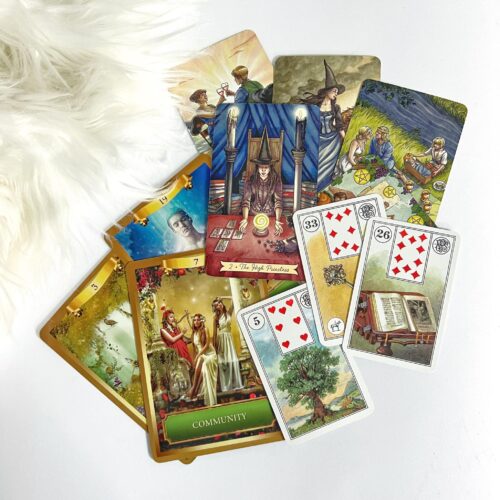
This is why intuition plays such a big role in Tarot, Lenormand, oracle cards, dream interpretation, meditation, and other spiritual practices. These tools give intuition a language. They help you slow down, notice what is already speaking within you, and interpret the symbols, feelings, and impressions that arise.
Also from a spiritual perspective, intuition can include feeling someone’s energy or “aura“. Sometimes you meet someone and immediately feel comfortable around them; other times, something about their energy simply feels off. This can be especially noticeable for people who are clairsentient or sensitive to the energy around them.
This is one reason I’ve always taught my kids, “Don’t just listen to someone’s words; pay attention to their actions—especially if you aren’t sure whether you can trust your intuition.” Your intuition may give you a feeling about someone, but their actions can help you decide what to do with that feeling.
The practical perspective helps us stay grounded. The spiritual perspective helps us stay open.
Together, they create a balanced way of understanding intuition: your inner knowing is not something strange or unreachable. It is a natural ability that can become stronger with attention, practice, and trust.
What Intuition Feels Like
This is where things get tricky because intuition doesn’t feel exactly the same for everyone.
Some people literally experience a gut feeling. There may be a sensation in the stomach, chest, or elsewhere in the body.
Other people receive intuition through thoughts.
You might suddenly think:
Take the other road.
Call your sister.
Don’t buy this.
Ask another question.
There’s no dramatic voice from the heavens. The thought simply appears.
Intuition can also feel like:
- An immediate sense of knowing
- A physical sensation or reaction
- A sudden mental image
- A word or phrase appearing in your mind
- An unexpected idea
- A feeling of being drawn toward something
- A feeling of resistance toward something
- A strong sense that something is right or wrong
- Recognizing a pattern before you can explain it
- A quiet feeling of certainty
One important thing to understand is that intuition isn’t always dramatic.
In fact, it often isn’t.
Sometimes intuition is incredibly boring.
It’s simply:
This one.
And that’s it.
No fireworks. No chills. No mystical music playing in the background.
You just know.
Common Ways Intuition Communicates
Intuition does not communicate the same way for everyone.
Some people feel it in the body. Some hear inner words. Some see images. Some simply know. Some receive information through dreams, synchronicities, repeated numbers, card readings, memories, songs, or sudden ideas.
Here are some of the most common ways intuition may communicate:
- A gut feeling
- A sudden knowing
- A repeated thought
- A strong first impression
- A body sensation
- A dream that stays with you
- A symbol or image in your mind
- A phrase that appears internally
- A pull toward or away from something
- A sense of timing
- Goosebumps, chills, warmth, or expansion
- A card, sign, or synchronicity that feels meaningful
The key is not to force your intuition to arrive in one specific way. Instead, pay attention to how it naturally speaks to you.
If you keep waiting for visions but your intuition comes through as knowing, you may miss it. If you keep expecting a loud inner voice but your intuition speaks through your body, you may overlook the message.
Your intuitive language may be quieter, simpler, or more familiar than you expect.

The Four Clairs and Intuitive Senses
When people begin exploring intuition from a spiritual perspective, they often come across the four main clairs.
The word clair comes from French and means “clear.”
The four intuitive senses most commonly discussed are clairvoyance, clairaudience, clairsentience, and claircognizance.
And despite how dramatic some of these names sound, they can actually be surprisingly subtle.
Clairvoyance — Clear Seeing
Clairvoyance is intuitive information received visually.
That doesn’t necessarily mean seeing spirits standing in your living room.
Clairvoyance can be much quieter than that.
You might see an image, symbol, color, memory, person, or scene in your mind.
Think about how you visualize something when you’re imagining it. Clairvoyant impressions can sometimes appear in a similar mental space, except you didn’t intentionally create the image.
It simply appears.
Clairaudience — Clear Hearing
Clairaudience means receiving intuitive information through sound or words.
Again, this doesn’t necessarily mean hearing a literal external voice.
It may feel more like an internal word, sentence, name, song, or phrase suddenly appearing in your mind.
Sometimes you may hear exactly what you need to know.
Other times, the information may be symbolic.
Clairsentience — Clear Feeling
Clairsentience is intuitive information received through feelings and physical sensations.
You may walk into a room and immediately feel the mood.
You may physically sense another person’s nervousness or excitement.
You might get chills, heaviness, warmth, pressure, butterflies, or another bodily response connected to intuitive information.
Highly empathic people may naturally lean toward clairsentience.
The challenge is learning the difference between what you’re feeling and what you may be picking up from someone or something around you.
Claircognizance — Clear Knowing
And then there’s one of my personal favorites: claircognizance.
Claircognizance means clear knowing.
There isn’t necessarily an image.
There isn’t necessarily a voice.
There isn’t necessarily a physical sensation.
You simply know.
Someone asks you a question and the answer appears instantly.
You know how a situation will turn out.
You know someone is about to contact you.
You know which decision is right.
And when someone asks:
“But how do you know?”
Your answer is basically:
“I don’t know. I just do.”
Claircognizance can be particularly difficult to trust because there isn’t always anything tangible attached to it.
There’s no image to interpret or physical sensation to point toward.
It’s just information.
And if you’ve spent your entire life being taught that you need to explain exactly why you think something, you may have learned to dismiss that kind of knowing.

Intuition vs. Instinct
Intuition and instinct are often used interchangeably, but there is a subtle difference.
Instinct is generally an automatic biological response.
Think about pulling your hand away from something hot, reacting to a sudden loud noise, protecting a child, or immediately jumping backward when something comes flying toward you.
Instinct is deeply connected to survival.
Intuition is more about knowing or perceiving information without conscious reasoning.
For example, if you are walking to your car and suddenly feel a strong urge to take a different route, that may be instinct and intuition working together. Your body may have picked up on something before your mind understood it. The message is immediate: move differently.
But if you are deciding whether to take a new job and you keep receiving a quiet inner knowing that the opportunity is not aligned, that may be intuition working in a more reflective way. It may not be an emergency. It may not feel like danger. It may simply feel like truth.
Instinct is often fast, physical, and protective.
Intuition can be fast too, but it can also be subtle, symbolic, spiritual, and deeply wise.
Instinct reacts. Intuition informs.
Both are valuable. Both deserve attention.
Intuition vs. Anxiety or Fear
One of the most common questions people have when learning to trust their intuition is:
How do I know if this is intuition or anxiety?
Unfortunately, there isn’t a magical test that works 100% of the time.
However, there are some patterns you can learn to recognize.
Intuition often feels relatively simple.
Don’t go.
Call them.
Wait.
Choose this one.
Anxiety tends to build a story.
What if this happens? And then this happens? And then everything falls apart? And what if I make the wrong choice? What if they hate me? What if…
Fear can also be loud, urgent, and repetitive.
Intuition is often quieter and more matter-of-fact.
That doesn’t mean intuition always feels peaceful. An intuitive warning can absolutely make you afraid. The difference is that the information itself may arrive before the fear does.
You might suddenly think:
Something isn’t right.
And then your emotional reaction kicks in.
Learning to separate the initial information from everything your mind adds afterward can be incredibly helpful.
It is also important not to assume that every uncomfortable feeling is a psychic warning. Stress, trauma, previous experiences, anxiety, expectations, and ordinary emotions can all affect how we perceive situations.
Intuition is a tool—not a reason to ignore reality.
Everyday Examples of Intuition
We tend to make intuition sound mystical, but you’re probably using it much more often than you realize.
Intuition is not only for spiritual work. It shows up in ordinary life all the time.
You may experience intuition when:
- You feel pulled to check on someone, and they needed support.
- You know a decision is right before you can explain why.
- You choose a different route and later discover there was traffic or a delay.
- You meet someone and immediately sense whether they feel trustworthy.
- You wake up from a dream that seems to answer a question.
- You feel guided to pick up a certain book, card deck, or message.
- You think of someone right before they text or call.
- You get a creative idea that solves a problem instantly.
- You feel a quiet no around something that looks good on paper.
- You sense that a conversation is not really about what is being said on the surface.
These moments may seem small, but they matter.
Intuition often builds trust through small confirmations. The more you notice those little moments, the easier it becomes to recognize how your intuition speaks.
This is especially helpful because intuition rarely develops through one big experience. It usually strengthens through repeated attention. You notice. You record. You reflect. You compare what you sensed with what later unfolded.
Over time, you begin to recognize your own intuitive patterns.
Why People Stop Trusting Their Intuition
Many people are naturally intuitive, but they learn to ignore it.
This can happen for many reasons.
You may have been told you were too sensitive, too imaginative, too emotional, or too much. You may have received intuitive impressions as a child but learned to dismiss them because the people around you did not understand them.
This often starts in childhood. Children can be surprisingly intuitive because they haven’t necessarily learned to analyze or second-guess every feeling yet. They respond to people, environments, emotions, and impressions very naturally.
As we grow up, we start hearing things like:
“You’re imagining things.”
“You’re overthinking it.”
“There’s no reason to feel that way.”
“That doesn’t make sense.”
And over time, we start to think that information only counts if we can logically explain it.
So we start overriding ourselves.
We notice something feels wrong but tell ourselves we’re being ridiculous.
We know what we want but ask ten other people what they think.
We receive an immediate answer and then spend three days analyzing it until we’re completely confused.
Past experiences can also make trusting yourself difficult.
Maybe you mistook fear for intuition.
Maybe you ignored your intuition and regretted it.
Maybe you were taught not to trust your own judgment.
Or maybe you’re simply so accustomed to looking outside yourself for answers that you don’t recognize your own inner voice anymore.
You may also have talked yourself out of your own knowing because it did not make logical sense at the time.
This is common.
Intuition often speaks before proof arrives. That does not mean you should ignore evidence or make major choices without thinking things through. But it does mean intuition may show up before the full picture is visible.
People also stop trusting their intuition when they confuse it with wishful thinking, fear, or old emotional patterns. If something did not turn out the way they expected, they may decide their intuition was “wrong,” when the situation may have been more complicated.
Another reason people stop trusting intuition is that they expect it to be perfect.
Intuition is a sense—your sixth sense to be exact. Like any sense, it can be refined and interpreted more clearly over time. You can receive a true intuitive impression and still misunderstand what it means. You can sense something important but attach the wrong story to it. You can feel a no, but not yet know whether the no is about the person, the timing, the method, or your own readiness.
This is why reflection matters.
The goal is not to pressure yourself to be perfectly intuitive. The goal is to build a relationship with your inner knowing.
Learning to Trust Yourself Again
Developing intuition isn’t necessarily about becoming more psychic.
Sometimes it’s about becoming more aware.
You’re learning to notice the little signals you used to ignore.
You’re recognizing how your body responds.
You’re noticing the thoughts that arrive before you start analyzing.
You’re learning which intuitive senses come naturally to you.
You’re paying attention to patterns.
And you’re becoming more comfortable saying:
“I don’t know why yet, but something about this feels important.”
You don’t need to believe every intuitive impression you have.
You don’t need to get everything right.
And you definitely don’t need to turn every coincidence into a message from the universe.
Just start paying attention.
Because sometimes the hardest part of developing intuition isn’t learning how to receive information.
It’s realizing that you’ve been receiving it all along.

Simple Exercises to Strengthen Your Intuition
Intuition is something you can strengthen through practice.
You don’t have to force it or turn every decision into a spiritual exercise. In fact, practicing with small, low-stakes situations is usually much easier.
1. Pay Attention to Your First Impression
Before analyzing something, notice your immediate reaction.
What was the first thought?
The first feeling?
The first image?
The first physical sensation?
Don’t automatically assume it’s correct. Just notice it.
2. Keep an Intuition Journal
Write down intuitive impressions before you know the outcome.
This part is important.
This helps you separate intuition from memory, because memory is incredibly good at rewriting things after we know what happened.
Instead, record:
- What you sensed
- How the information arrived
- How strong it felt
- What you thought it meant
- What eventually happened
You may start noticing patterns, such as:
- Your intuition comes through most clearly in the morning.
- Your body gives you signals before your mind does.
- Your dreams answer questions symbolically.
- Your strongest impressions are often short and simple.
- Claircognizance shows up as sudden sentences or complete ideas.
Over time, these patterns teach you your own intuitive language. You may discover that your strongest impressions come through physical sensations, or that thoughts arriving instantly tend to be more reliable than the ones you analyze for twenty minutes.
3. Practice With Small Predictions
Keep it fun.
Before opening an email, notice what you expect it to say.
Before checking your phone, guess who messaged you.
When the phone rings, guess who’s calling.
Choose which checkout line will move faster.
Guess what color shirt someone will be wearing.
These things don’t matter—which is exactly why they’re useful for practice.
There’s very little emotional attachment to the answer.
4. Practice With Hidden Information
This is a simple exercise you can do with Tarot, oracle cards, or even playing cards.
Choose one card ahead of time, such as The High Priestess. Shuffle it into a small group of cards, then lay four cards facedown. Before turning them over, pause and notice which card you feel drawn to.
Do not overthink it. Just notice the pull.
Is it visual? Do your eyes keep going to one card? Is it physical? Does your hand want to hover over one? Is it claircognizant? Do you simply know, “It is that one”?
You can also practice without choosing a target card first. Pick one card and notice what comes to mind.
A color? Number? Suit? Image? Feeling?
Don’t pressure yourself to correctly identify the entire card; you’re practicing receiving impressions.
Then turn the cards over and check.
Whether you are right or not, the real value is in noticing how the information came through.
5. Give Yourself Quiet
Intuition can be difficult to hear when your mind is constantly consuming information.
This does not mean you need to meditate for an hour every day. It can be as simple as taking a walk without headphones, journaling for five minutes, sitting with your cards before pulling them, or giving yourself a quiet moment before making a decision.
Stillness helps you notice what has been speaking underneath the noise.
Using Intuition With Tarot and Other Divination Tools
Tarot, Lenormand, Oracle cards, pendulums, runes, and other divination systems can be wonderful tools for practicing intuition.
These tools do not replace your intuition. They give it structure.
Take Tarot as an example.
You pull a card.
Before opening a guidebook, look at it.
What catches your attention first?
A facial expression?
A color?
A symbol?
A person?
A tiny object in the background?
What feeling does the card give you?
What was your first thought?
That initial reaction can be incredibly useful.
You can then combine your intuitive impression with your learned understanding of the traditional card meaning.
You don’t necessarily have to choose between intuition and traditional meanings.
Use both.
The same applies to Lenormand, although Lenormand tends to have a more structured symbolic language. Your intuition may help you understand how those symbols apply to the particular question or situation.
Oracle decks tend to offer even more freedom for intuitive interpretation.
Divination tools can become almost like a bridge between your conscious mind and your intuitive mind.
They give you imagery, symbolism, archetypes, words, and patterns to respond to.
And the more you practice noticing your immediate responses, the easier intuitive reading can become.
A strong reading usually comes from the relationship between structure and intuition. You learn the meanings, understand the spread, and then listen for what stands out. You ask, “Why this card? Why this symbol? Why this feeling? Why this message now?”
That is where readings become alive.
Intuition Doesn’t Mean Ignoring Logic
Developing your intuition doesn’t require throwing logic out the window.
Actually, I think the two work beautifully together.
Intuition can tell you:
Look closer.
Logic can help you figure out why.
Intuition can say:
Something isn’t adding up.
Evidence can help you determine whether that’s true.
Intuition can point you toward a possibility.
Research can help you evaluate it.
You don’t have to choose between being intuitive and being rational.
Use every tool available to you.

Frequently Asked Questions About Intuition
Is intuition the same as a gut feeling?
A gut feeling is one way intuition can appear, but intuition isn’t limited to physical sensations.
Some people experience intuitive information through their stomach, chest, chills, or other bodily reactions. Others experience sudden thoughts, images, words, emotions, or simply a sense of knowing.
Your “gut feeling” may literally be physical—or it may simply be the phrase you use for an internal sense that something is right or wrong.
Is everyone intuitive?
Everyone appears capable of processing information outside of conscious awareness, and many spiritual traditions also teach that everyone has some degree of intuitive ability.
However, intuition may be much more noticeable in some people than others.
Just like any other skill, paying attention to it can make it easier to recognize.
Is intuition a psychic ability?
That depends somewhat on how you define psychic ability.
Intuition can refer to subconscious information processing and pattern recognition, while psychic intuition is generally understood as receiving information beyond the ordinary five senses.
From a spiritual perspective, abilities such as clairvoyance, clairaudience, clairsentience, and claircognizance may all be considered forms of intuitive or psychic perception.
There can be plenty of overlap between these ideas.
What is claircognizance?
Claircognizance means “clear knowing.”
It describes receiving information as an immediate sense of knowledge without necessarily knowing where that information came from.
You don’t see it.
You don’t hear it.
You may not physically feel it.
You simply know.
How can I tell intuition from anxiety?
Intuition often arrives as relatively simple information, while anxiety tends to create ongoing thoughts, possibilities, and “what if” scenarios.
However, they can overlap, and there isn’t a perfect rule that works for everyone.
Keeping an intuition journal can help you identify your own patterns over time.
And if anxiety is significantly affecting your daily life, intuition exercises shouldn’t replace appropriate mental health support.
Can intuition be wrong?
Absolutely.
Human beings can misinterpret feelings, notice patterns that aren’t actually meaningful, project expectations onto situations, or mistake fear and desire for intuition.
Developing intuition isn’t about assuming you’re always right.
It’s about becoming better at noticing, recording, evaluating, and understanding your intuitive impressions.
Can Tarot help develop intuition?
Yes. Tarot can be a wonderful tool for practicing intuition because the imagery and symbolism give your mind something to respond to.
Before looking up a Tarot card’s traditional meaning, notice your first reaction.
What catches your eye?
What feeling does the card create?
What story do you see?
What immediately comes to mind?
Then compare those impressions with the card’s traditional meaning.
Over time, this can help you become more comfortable recognizing your own intuitive language.
How long does it take to develop intuition?
There isn’t a set timeline because you’re probably not starting from zero.
You may already be using intuition every day without recognizing it.
Instead of focusing on how long it takes to “become intuitive,” start paying attention to how intuition already shows up in your life.
Notice it.
Write it down.
Test it.
And most importantly, give yourself permission to be curious about it.
Your intuition doesn’t have to shout to be worth listening to.
Intuition Is a Relationship With Your Inner Knowing
You already have intuition, whether you recognize it or not. Developing it is really about figuring out how your intuition speaks to you and learning to trust it when it does.
It may show up as instinct, claircognizance, a gut feeling, a dream, a symbol, a card, a sudden thought, or a quiet sense that something is true. It may be practical, spiritual, or both. It may speak loudly in rare moments, but most of the time, it speaks softly.
The more you listen, the more familiar its voice becomes.
You do not need to be perfect at interpreting every signal. You do not need to prove every impression immediately. Start small. Notice what you feel, know, sense, and perceive. Write it down. Reflect on it. Practice with everyday moments.
Over time, intuition becomes less mysterious in the best possible way.
It becomes a trusted part of how you move through the world.
As always, trust your intuition!

Written text and images © 2026 Sonya Blackstone of Clear Intuitions. Do not copy. Link to this post to share this content. All Rights Reserved.
Sonya Blackstone is a participant in the Amazon Services LLC Associates Program, an affiliate advertising program designed to provide a means for us to earn fees by linking to Amazon.com and affiliated sites.