Tarot vs. Lenormand vs. Oracle: What Are the Differences Between Them?
What are the differences between Tarot cards, Lenormand cards, and Oracle cards? If you’ve ever searched for Tarot vs. Lenormand, Tarot cards vs. Oracle cards, or wondered which cartomancy system is right for you, you’re not alone. This is one of the most common questions new readers ask, which is exactly why I wrote this guide.
At no extra cost to you, I may receive a small commission from purchases made through affiliate links, which allows me to continue to bring you awesome free content! This post contains affiliate links.
At first glance, the differences between these systems seem fairly simple. However, once you begin reading with them, you’ll quickly discover that each has its own philosophy, strengths, and unique way of communicating. So, let’s take a look at each cartomancy system and compare. While all three are types of divination cards used in cartomancy, they each have their own history, reading style, and strengths.
| Feature | Tarot | Lenormand | Oracle |
|---|---|---|---|
| Deck Size | 78 Cards | 36 Cards | Varies |
| Learning Curve | Complex | Mid | Beginner-friendly |
| Reading Style | Intuitive + Symbolic | Literal + Combinations | Inspirational + Intuitive |
| Memorization | Extensive | Moderate | Minimal |
| Card Meanings | Layered, Symbolic | More specific | Written on card |
| Best For | Deep guidance | Clear Answers | Encouragement + Insight |
| Yes/No Answers | Not Usually | Yes | Not Usually |
What are Tarot Cards?
Tarot is my first love and is probably the best-known of all the cartomancy systems. It’s the first system I learned, and I have been hooked to it since the first time someone pulled out a deck and read me over 20 years ago.
I would also say this is the most complex of all the systems.
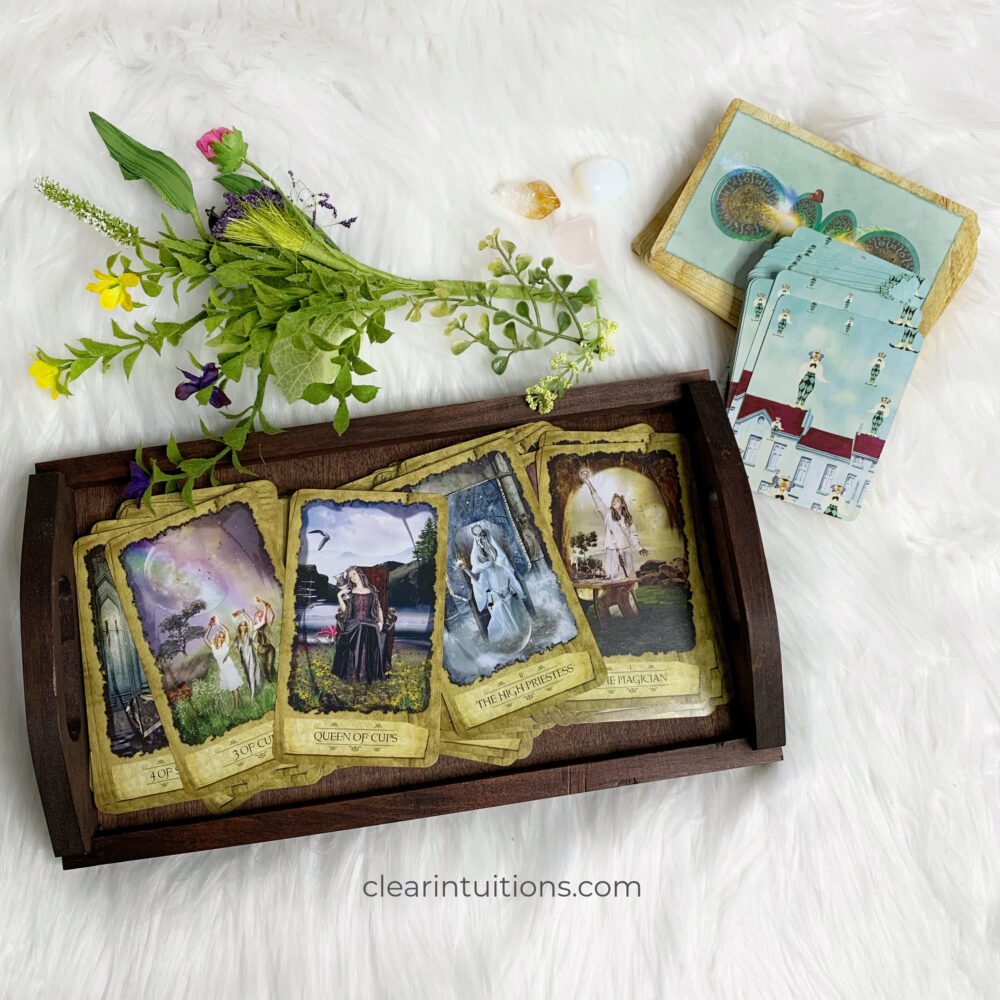
One thing that surprises many beginners is that Tarot isn’t just one single system. There are actually several different Tarot traditions, with the three most well-known being the Rider-Waite-Smith, Thoth, and Marseille systems. While they all use a 78-card structure, the artwork, symbolism, and even some card interpretations differ between them.
Today, the vast majority of modern Tarot decks are based on the Rider-Waite-Smith tradition, which is why you’ll often see its imagery and meanings referenced in books, courses, and online tutorials.
Tarot is meant to be read through a combination of intuition, symbolism, and traditional meanings. Every card has a core message, but that message shifts depending on the question being asked, the surrounding cards, and sometimes even the reader’s own intuitive impressions. That’s part of what makes Tarot so fascinating, you can spend years studying it and still continue discovering new layers. So, there is a memorization process involved that can be incredibly difficult and can take years to learn, especially if you don’t have your cards out doing readings on a regular basis.
Since there are 78 cards in a standard tarot deck, that’s a lot of learning. Plus, all cards can also be read upside down, also know as reading reversals, which give them new meanings. Because of this flexibility, two experienced Tarot readers can interpret the exact same spread slightly differently and both arrive at accurate, meaningful guidance. Tarot isn’t about memorizing one rigid definition for every card, it’s about learning the language of the cards and allowing intuition to guide how that language is spoken. Not everyone reads reversals though, so that’s totally up to you!
For example, the Sun card as a stand alone is the most positive card in the deck. It means Bliss and all the wonderful things that come along with that feeling.
However, if you were to do a Past, Present, Future reading and find Sun in the past position, 10 of Swords in the present position, and the Tower in the future position, then that means your bliss is short lived and you’re in for a painful surprise that’s going to cause upheaval in your life or it can also mean that you were tricked into believing it was bliss. And of course, the type of reading you’re doing and the number of cards in the spread all will give more detail.
Another thing that makes Tarot a hard system to learn is the court cards. Even seasoned readers can get tripped up here, because these cards are unique in their own right: they can stand for a situation or a specific person.
For instance, the Page of Cups can stand for creativity, curiosity, and even intuitive messages, but it can also stand for a person. Pages usually represent a child or teen, sometimes even an immature young adult (or someone with extreme childlike qualities). Physically the person may have blue or hazel eyes and blonde or light brown hair.
The most beautiful thing about this system is that it’s an intuitive system, so that means you can assign a certain meaning to these cards and when they pop up you know from your own intuitions what the cards are representing.
For example, when the Seven of Wands appears, you may look at it and feel “challenges”, while other readers may always feel “perseverance”. Neither is wrong, since they are both potential meanings of that card, but you may just choose one, so that whenever that card comes up it comes up because someone is facing challenges in their life.
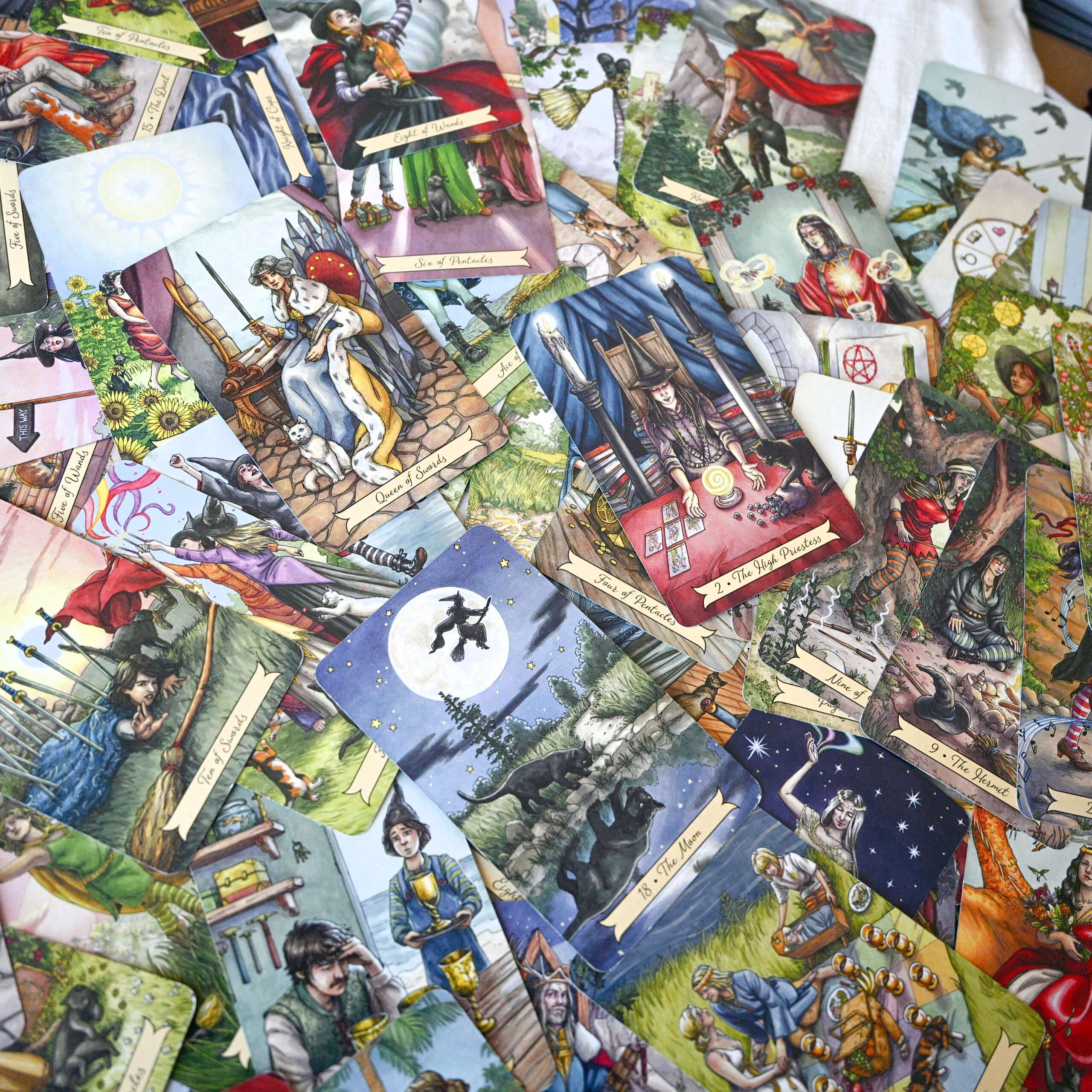
This is also why I highly suggest finding a deck with artwork you can really connect to. If you’re in love with the art, your soul connects (in my opinion), and it makes remembering what the card is saying so much easier. For me I love the Everyday Witch Tarot art by Elisabeth Alba and the Crystal Visions Tarot by Jennifer Galasso.
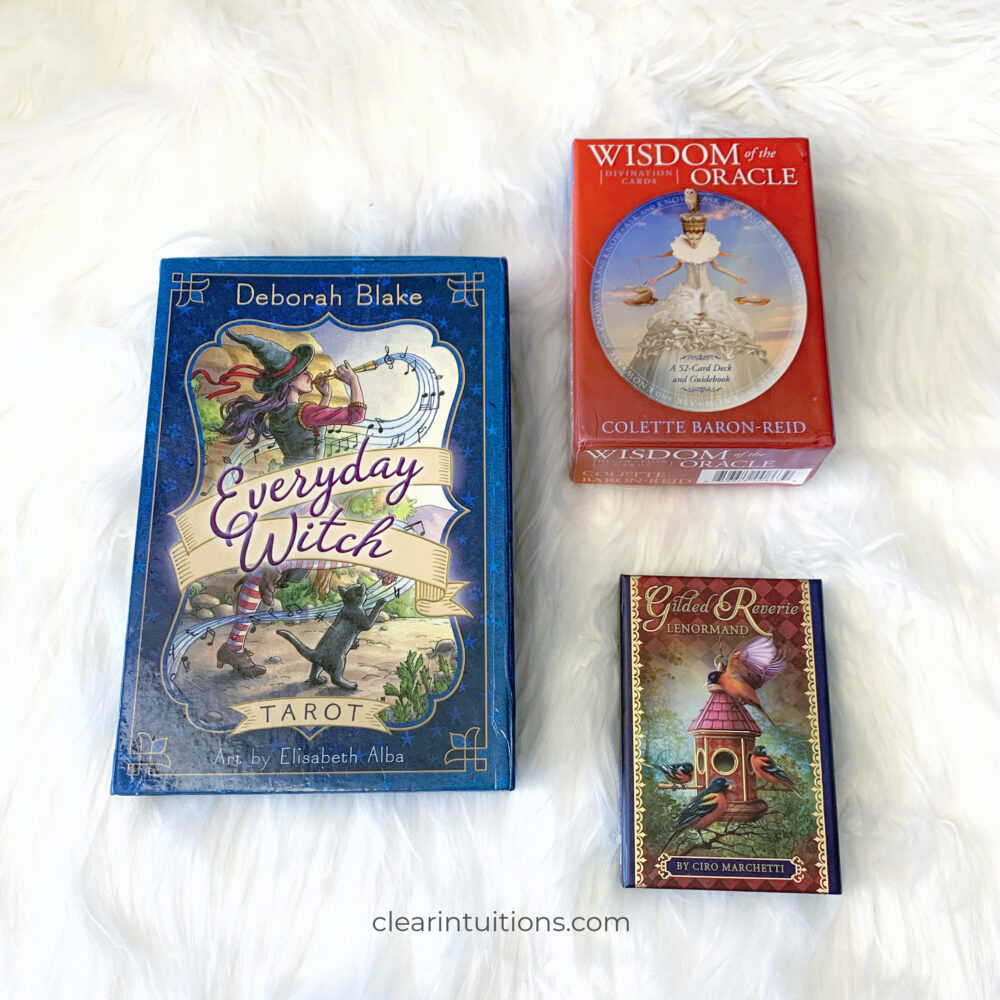
Everyday Witch Tarot
Wisdom of the Oracle
Gilded Reverie Lenormand
The artwork is absolutely beautiful, but also has a whimsical flair, which totally speaks to me. They are also detailed enough to get an idea of what the cards represent; Having these decks has made Tarot reading so much easier for me.
The artwork in Tarot card features symbolism that’s important to the meaning as well. For instance, a red rose represents love, passion, and/or romance. There are many simplistic decks out there that will feature little to no symbolism, but for the most part, these key elements will be in there because they are important to the Tarot system.
For many people beginning their journey into card reading, Tarot feels intimidating because of the number of cards and the amount of symbolism involved. While it does require study, it also rewards you with incredible depth and flexibility.
What are Lenormand Cards?
If you’ve been comparing Lenormand vs. Tarot, one of the biggest surprises is just how differently the two systems communicate.
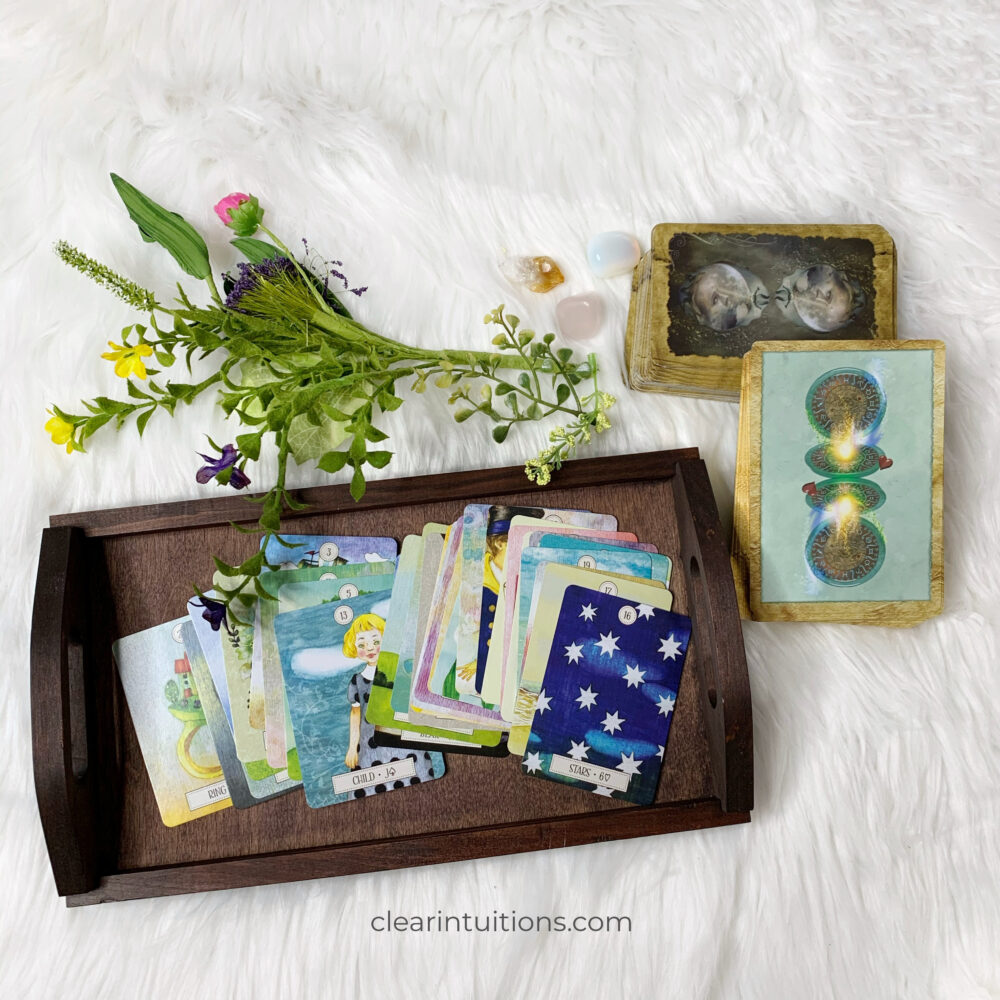
Lenormand is another cartomancy system that was used for “fortune telling”. Lenormand, while historically well-loved and used, kind of seems to hide in the shadows, as people usually think of Tarot when they think of “card readings”.
What I love most about Lenormand is that it is straightforward. No guesswork, no nonsense, just in-your-face information.
Lenormand only has 36 cards and each one of them represents something that “just makes sense”. For example, if you pull the Clover card you might think “luck” and that’s good, because that’s what it means. If you pull the Dog card you might think “loyalty” and that’s good, because that’s what it means. This makes learning the cards incredibly easy. However, don’t let that fool you, because Lenormand also has its depth.
One of the biggest mindset shifts when moving from Tarot to Lenormand is learning that individual cards rarely tell the whole story. Instead, Lenormand is read like a sentence. Each card modifies the meaning of the next, creating very literal messages. Rather than asking “What does this one card mean?” you’re asking “What story are these cards telling together?”
Lenormand also tends to excel at practical questions. Readers often use it for questions about relationships, careers, finances, travel, timing, and everyday life because its messages are usually direct and concrete. While Tarot often explores the “why” behind a situation, Lenormand frequently answers the “what” and “when.”
This is one of the biggest differences between Tarot vs. Lenormand. Tarot often explores emotions, motivations, and spiritual lessons, while Lenormand focuses on practical events and straightforward answers.
Lenormand spreads can get quite involved. Some spreads can be as little as 3 cards, while other spreads can use all 36 cards. Whereas Tarot spreads don’t typically go beyond a 12 card spread and usually hover in the 3-5 range, it is more common to do a 9-36 card spread for Lenormand.
Another thing about Lenormand spreads is that, unlike tarot, you read the cards in different directions to get different bits of detail.
So with a Tarot 12-card spread you would have each card “slot” represent a different idea or situation, but with a Lenormand spread you would read each line differently depending on the spread.
You may read the cards just left to right, some you may read from left to right and top to bottom, some you may read in all directions around your significator. Each direction does have its own situation attached.
The order in which the Lenormand cards are read is also important to this system. You also need to understand what the cards mean when paired with other cards, since that’s how they are read (in twos).
The artwork on most Lenormand decks is usually as straightforward as their meanings, since the main focus is one specific object, but of course the decks feature beautiful artwork with varying levels of detail.
Tarot vs. Lenormand vs. Oracle


What are Oracle Cards?
When people compare Tarot cards vs. Oracle cards, Oracle is usually considered the easiest place to start because there are no standardized rules.
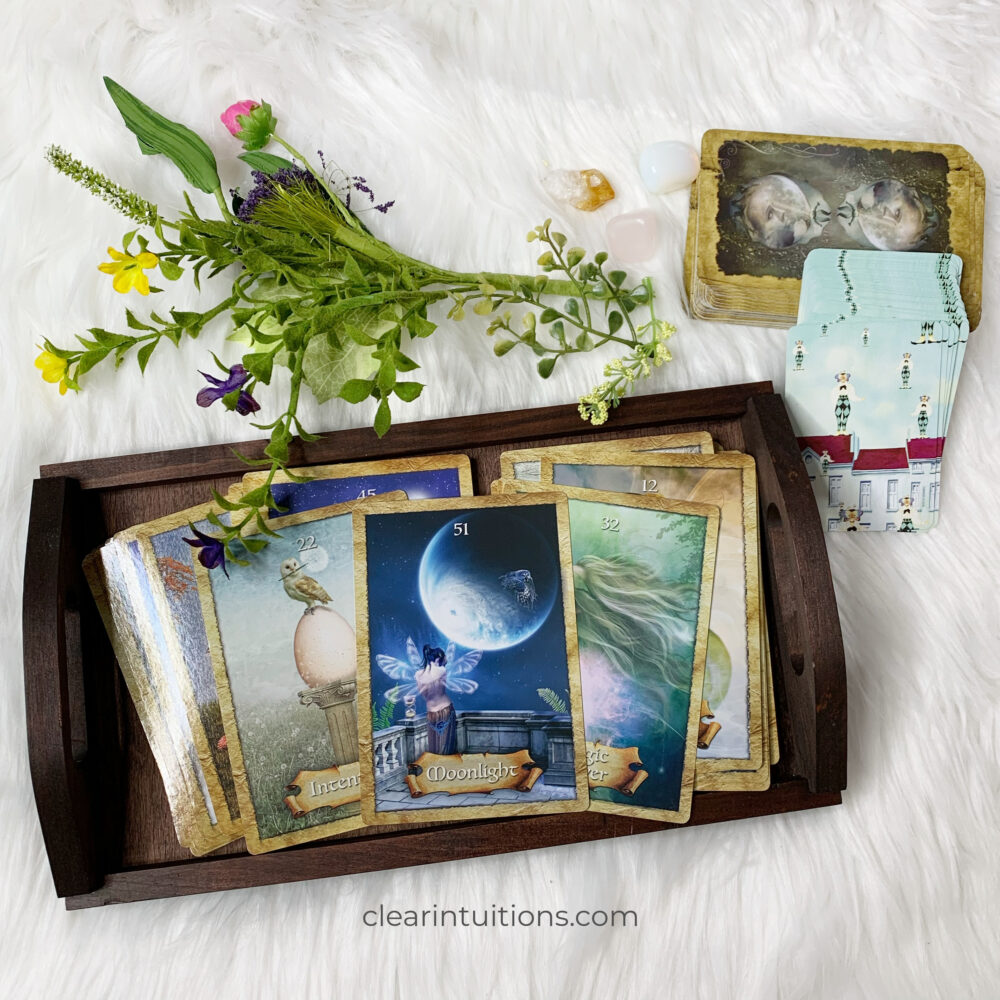
Oracle cards are sort of a “free rein” system. Each deck is different, they all have different themes, and the amount of cards can vary greatly. Many Oracle decks contain around 44 cards, but because there isn’t a standardized structure, you’ll find decks with far fewer, or many more; they can fall anywhere from 36-55 cards. But again, there is no real “standard” amount; I have decks with as little as 22 cards and decks with more than 60.
There is also very little memorization needed with this system, since each card is printed with its meaning. Sometimes they’re catchy little phrases that you need to peek in the book for, but generally they make sense as soon as you read them. The books are always good for getting a detailed message if your own intuition doesn’t quite lead you there.
Oracle cards can feature messages from the Angels / Archangels / Saints. They can be messages from the Fairies (if you believe in their existence). They can be Animal wisdom or Totem messages and even messages from your loved ones in Heaven. Of course they can be generalized decks as well, featuring beautiful themed artwork, but not necessarily “messages from…”.
The biggest difference between Tarot and Oracle cards is that Tarot follows an established structure of 78 cards, while every Oracle deck is completely unique. That’s what gives Oracle decks so much creative freedom.
They tend to focus more on guidance, encouragement, and personal growth than on predicting future events, but they do pair nicely with Tarot cards! For instance, if we did that Tarot Past, Present, and Future reading mentioned above and got that our bliss was going to be short lived and we were about to experience something painful, we may then pull an oracle card that gives us instructions or inspiration on how to deal with it.
For example, if I pull “The Tribe” card from my Wisdom of the Oracles deck by Colette Baron-Reid, it may mean that I need to turn to my loved ones for comfort, or maybe even join a support group of like minded people depending on what it is that I’m going through.
If I were to pull the “Here and Now” card from the same deck it may mean that I need to just take this situation one day at a time.
Or if I pulled the “Regeneration” card from the same deck it may be spirit’s gentle reminder that “this too shall pass” and like a phoenix you’ll rise from the ashes, because whenever the Tower comes along and tears things down, better things end up in their place.
Oracle cards may have artwork not necessarily connected to their meaning, which I find is often the case. The art seems purely decorative. I still think it’s important to connect to the deck’s artwork though. The more you enjoy the artwork, the more connected to your cards you will be.
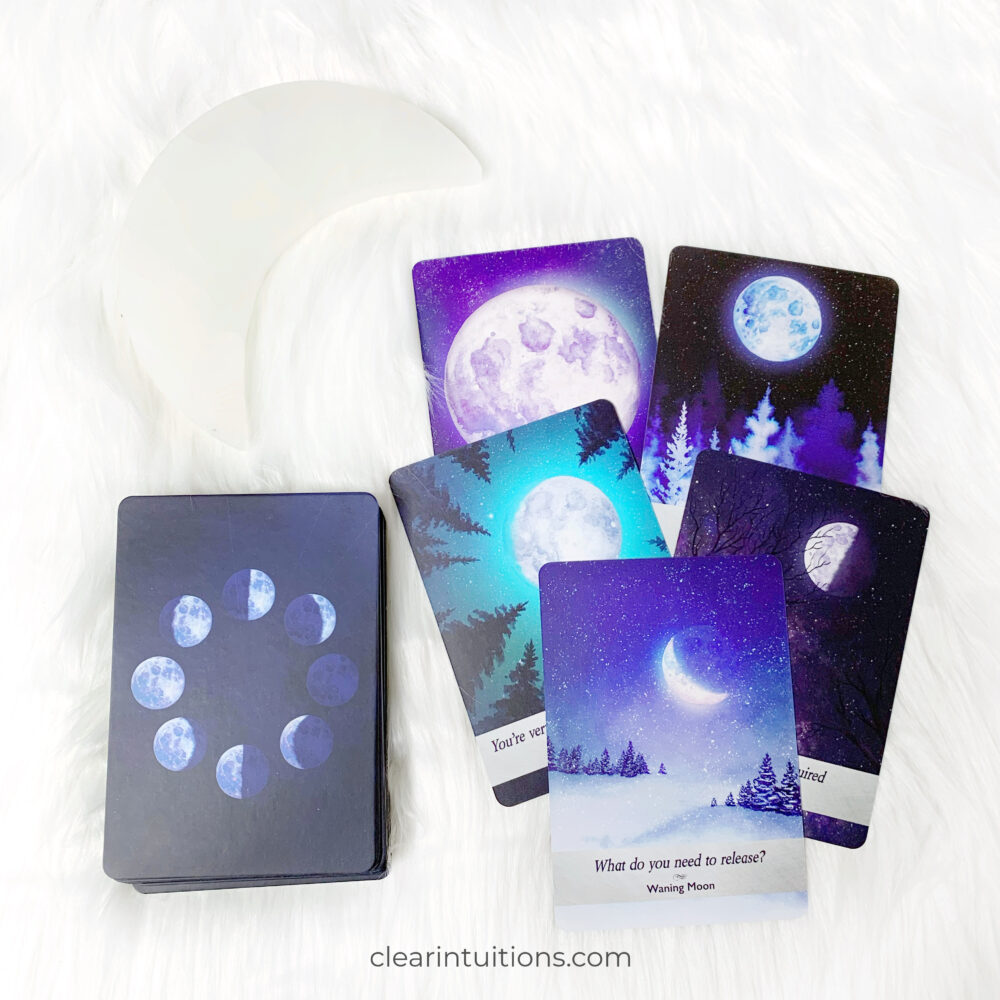
Because Oracle decks aren’t bound by a traditional system, creators have enormous freedom. One deck may focus on shadow work, another on astrology, another on crystals, ancestors, moon phases, chakras, or self-care. That’s exactly what makes Oracle cards so enjoyable. If there’s a topic you’re passionate about, there’s probably an Oracle deck designed around it.
Since every Oracle deck is unique, learning one deck doesn’t necessarily teach you another. Each creator develops their own symbolism, keywords, and style, making every Oracle deck its own experience.
Tarot vs. Lenormand vs. Oracle: Quick Differences
Another big difference in the cards is that with Tarot the cards are typically not used to answer “yes or no” questions, but Lenormand is! Oracle isn’t really a system in which you would even ask a “yes or no” question, but you could use them in that way if you wanted. This would be more of an intuitive interpretation though.
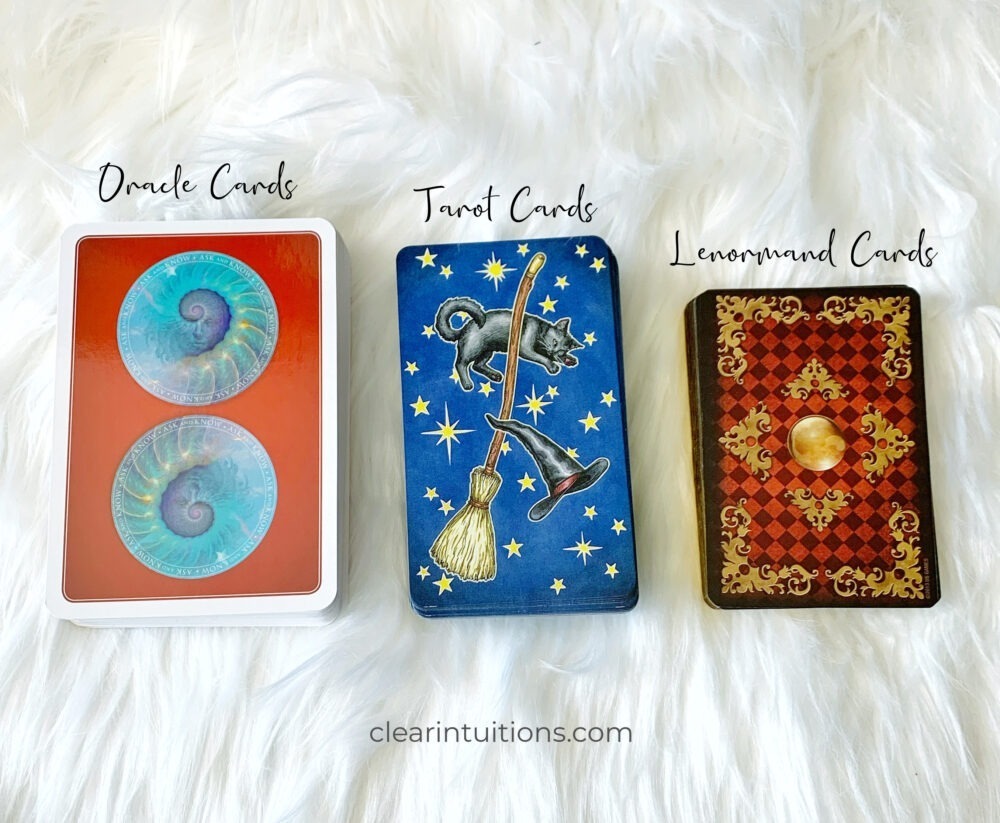
Also a marked difference between all decks is their size. Standard Lenormand cards are “tiny” compared to both Tarot and Oracle cards. Oracle cards are typically the largest. This can vary depending on the creator and publisher, but speaking in “standards” their sizes are much different.
Wisdom of the Oracle
Everyday Witch Tarot
Gilded Reverie Lenormand
Can You Use Tarot, Lenormand, and Oracle Together?
Absolutely! Many readers combine all three systems in a single reading. Tarot can reveal the deeper emotional or spiritual lesson, Lenormand can provide practical details about the situation, and Oracle cards can offer guidance, encouragement, or advice for moving forward. Rather than competing with one another, the three systems complement each other beautifully.
If I were to assign each cartomancy system a personality, I’d say Tarot is the wise therapist who asks the hard questions, Lenormand is the detective who gives you the facts, and Oracle is the life coach who reminds you that you’ve got this. Or maybe Tarot are the witches, Lenormand are the travelers, and Oracle are the free spirits. Either way, each has its own personality and style… and that’s part of what makes learning them so much fun.
Which Card System Is Right for You?
There’s no “best” card system—only the one that best fits your personality and what you’re hoping to gain from your readings.
Choose Tarot if…
- You love symbolism and storytelling.
- You enjoy learning and studying.
- You want deep personal insight.
- You don’t mind spending time mastering a system.
Choose Lenormand if…
- You prefer direct answers.
- You enjoy puzzles and patterns.
- You like practical guidance.
- You want straightforward readings with less ambiguity.
Choose Oracle if…
- You’re brand new to card reading.
- You want encouragement and inspiration.
- You enjoy collecting beautiful themed decks.
- You’d rather spend time reflecting than memorizing.
Or…do what many readers eventually do and use all three! Each system has its own strengths, and many readers combine them to create readings that are both detailed and deeply personal.
Whether you choose Tarot, Lenormand, Oracle, or eventually fall in love with all three, remember that no deck is “better” than another. They simply answer different kinds of questions in different ways. The more time you spend working with a system, the more fluent you’ll become in its unique language… and that’s when the real magic begins.
I hope this article helped you understand the difference between the different cartomancy systems and maybe it even helped you to choose whether tarot, Lenormand, or oracle is right for you (or maybe all three!) There is definitely a need for all types of card divination systems and a need for readers of all types, too!
If you’re new to card reading, you can check out my Tarot by Comparison™ series to help you learn Tarot, or my Lenormand Card Meanings posts to help you learn Lenormand Meanings plus combinations. I will have a series on Oracle cards at a later date!
Sending Love & Light!

Written text and images © 2022 Sonya Blackstone of Clear Intuitions. Do not copy. Link to this post when sharing. All Rights Reserved.
Sonya Blackstone is a participant in the Amazon Services LLC Associates Program, an affiliate advertising program designed to provide a means for us to earn fees by linking to Amazon.com and affiliated sites.